Metal in Motion: How Electromigration Silently Destroys High-Current Circuits Over Time
A circuit passes its bench tests without complaint. It survives thermal cycling, vibration testing, and a full qualification suite. Then, fourteen months into field deployment, units begin returning with failures that defy easy diagnosis—intermittent dropouts, localized heating, and eventually open conductors with no obvious cause. In many such cases, the culprit is not a design oversight in the conventional sense. It is a fundamental physical phenomenon that has been quietly at work since the moment the device first powered on.
Electromigration is that phenomenon. It is slow, invisible, and almost never caught by standard functional testing. For engineers working on high-current applications—motor drivers, power converters, automotive electronics, or industrial control systems—understanding how electromigration operates is not an academic exercise. It is a prerequisite for building hardware that endures.
What Electromigration Actually Is
At its core, electromigration describes the gradual displacement of metal atoms within a conductor caused by momentum transfer from moving electrons. When current density is high enough, the electron flow exerts a measurable force on the metal lattice. Over time, atoms drift in the direction of electron travel—from cathode toward anode—leaving voids in some regions and accumulating as hillocks or whiskers in others.
Voids reduce the effective cross-sectional area of a conductor, increasing local resistance and generating additional heat. That heat accelerates atomic migration further, creating a self-reinforcing degradation cycle. Hillocks, meanwhile, can bridge adjacent traces or puncture insulating layers, introducing short circuits in circuits that were perfectly isolated at manufacture.
The phenomenon was first systematically studied in the 1960s in the context of integrated circuit interconnects, where narrow aluminum traces carried current densities that macroscale wiring would never approach. As feature sizes have continued to shrink and current demands have grown, electromigration has become increasingly relevant not just to chip designers but to PCB layout engineers and systems architects as well.
Why Engineers Underestimate the Threat
The primary reason electromigration escapes early attention is its timescale. Failures rarely manifest during product development or even early production. The physics governing mean time to failure—described mathematically by Black's Equation, developed by James Black at Motorola in the 1960s—shows that failure time depends on current density raised to an empirical power, multiplied by an Arrhenius temperature factor. Small increases in current density or operating temperature produce disproportionately large reductions in service life.
This nonlinearity creates a dangerous gap between what bench testing reveals and what field conditions produce. A trace that handles a nominal 2A load in a temperature-controlled lab may carry 2.8A during a summer afternoon in an Arizona vehicle cabin, at an ambient temperature thirty degrees Celsius higher than the test environment. Neither condition alone triggers immediate failure. Together, they compress a ten-year service life into eighteen months.
Additionally, many engineers apply current-carrying capacity guidelines derived from thermal considerations alone—IPC-2152 being the most widely referenced standard in the US. These guidelines address temperature rise but do not directly address electromigration, which is governed by current density at the atomic scale. A trace that stays cool enough by thermal standards may still be operating at a current density that initiates long-term atomic migration.
Identifying Vulnerable Points in a Design
Not all conductors in a circuit face equal electromigration risk. Several structural and contextual factors determine which traces and interconnects are most vulnerable.
Narrow traces carrying sustained DC current represent the highest risk category. Pulsed or AC currents are generally less damaging because electron momentum reverses direction, limiting net atomic displacement. Sustained unidirectional current in a narrow conductor is the classic electromigration scenario.
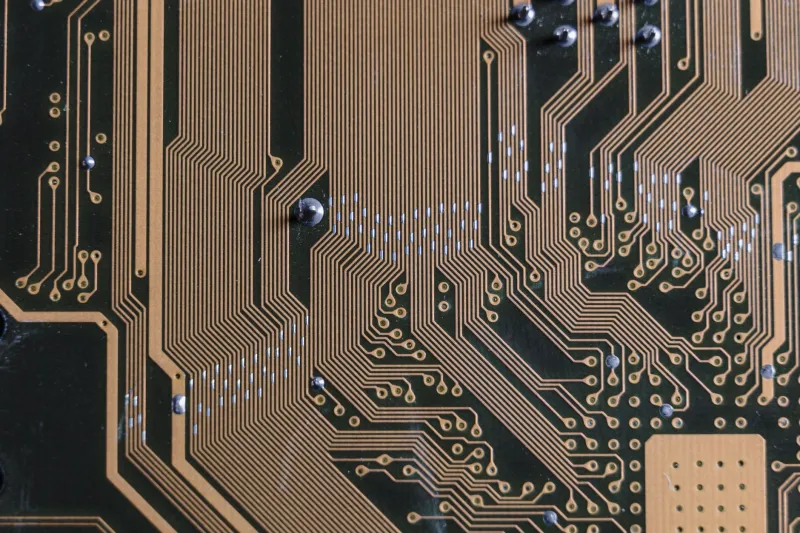
Via structures deserve particular scrutiny. The interface between a via barrel and the surrounding copper plane concentrates current at a geometric discontinuity. Even when the trace itself is adequately sized, insufficient via copper thickness or poorly formed barrel plating creates a localized high-density region prone to early failure.
Solder joints in high-current paths are frequently overlooked. Tin-silver-copper alloys used in lead-free soldering are susceptible to electromigration under sustained current, particularly at elevated temperatures. Ball grid array packages in power management ICs and solder-attached busbars in power modules both warrant careful analysis.
Aluminum bond wires inside packaged semiconductors remain a classic failure site. Despite decades of awareness, thermal and current density margins in discrete power components are not always published with sufficient granularity to allow confident derating calculations.
Practical Mitigation Strategies
Addressing electromigration risk does not require exotic materials or radical redesign. A structured set of engineering practices substantially reduces exposure.
Derate current density aggressively. Rather than designing to the maximum rated current capacity of a trace, target fifty to seventy percent of that value for any conductor carrying sustained DC loads. The nonlinear relationship between current density and failure time means that modest derating produces a compounding improvement in longevity.
Widen critical traces and multiply vias. Where board real estate permits, increasing trace width directly reduces current density. For via structures, placing multiple vias in parallel at high-current nodes distributes the load and eliminates the single-point failure that an undersized via represents.
Manage thermal environment deliberately. Because temperature and current density interact multiplicatively in electromigration physics, reducing operating temperature has an outsized impact on service life. Proper thermal relief, copper pours connected to ground planes, and component placement that minimizes localized heating all contribute to electromigration margin.
Simulate before you fabricate. Several commercial PCB design tools now include current density simulation capabilities. Running a DC current analysis on a completed layout identifies hotspots and narrow conductors under realistic load conditions before a single board is manufactured. This step costs hours at the design stage and can prevent costly field failures.
Apply Black's Equation as a design tool, not a post-hoc check. Estimating mean time to failure for critical conductors during the design phase—using realistic worst-case temperature and current assumptions—converts electromigration from an abstract concern into a quantifiable design parameter with a defined margin.
The Long View on Reliability
Electromigration belongs to a category of failure mechanisms that punish designs optimized purely for initial performance. A circuit can be fast, efficient, and compact while still harboring the conditions for its own eventual destruction. The engineering discipline required to address electromigration—conservative current density margins, thermal awareness, and physics-informed simulation—is the same discipline that separates products built for longevity from those built only to pass qualification.
For students and early-career engineers, electromigration offers an important lesson in the gap between datasheet ratings and real-world reliability. For seasoned professionals, it serves as a reminder that some of the most consequential design decisions happen not during schematic capture, but during the unglamorous work of trace routing and thermal layout.
Building electronics that last requires understanding not just what a circuit does when it works, but what physics is acting on it every moment it operates. Electromigration does not announce itself. It simply accumulates, atom by atom, until the circuit it inhabits can no longer function.