Build Smarter, Not Harder: The 10 Tools That Will Transform Your Electronics Workbench in 2024
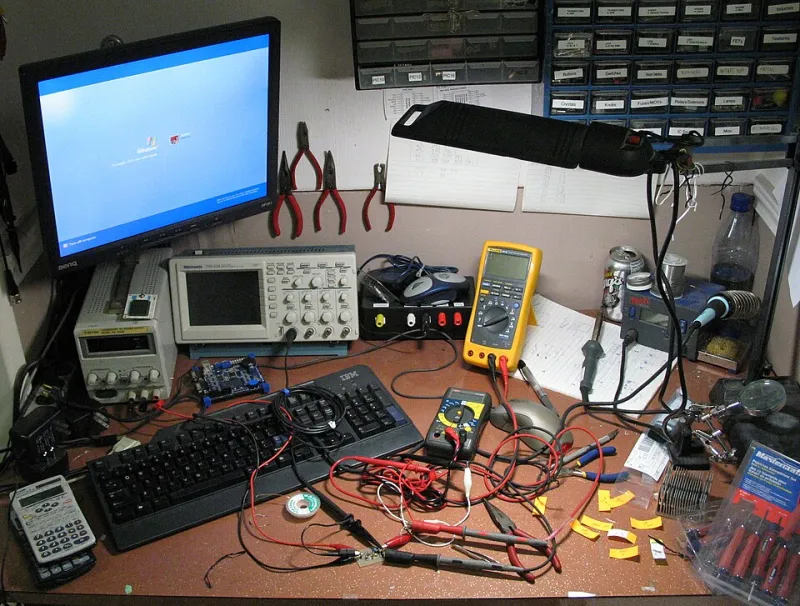
Photo: James Bastow, CC BY-SA 2.0, via Wikimedia Commons
There is a particular kind of frustration that every electronics enthusiast knows well: a circuit that refuses to behave, a signal that disappears somewhere between the schematic and the breadboard, a component that runs suspiciously warm. More often than not, the difference between diagnosing that problem in twenty minutes and spending three frustrated evenings on it comes down to having the right tool at hand.
The electronics hobby has never been more accessible. Component costs have dropped, open-source design resources are abundant, and online communities offer support at every hour of the day. Yet the workbench itself — the physical and digital toolkit that an enthusiast assembles over time — remains the single greatest determinant of how quickly skills develop and how ambitious projects can become.
The following ten tools represent our considered selection for 2024, chosen for their utility across a broad range of skill levels and project types. Whether your budget is tight or flexible, each entry offers a clear return on investment in capability and learning.
1. Entry-Level Digital Oscilloscope
Recommended starting point: Rigol DS1054Z or Siglent SDS1104X-E
No single instrument does more to demystify electronics than an oscilloscope. Seeing voltage waveforms in real time transforms abstract circuit behavior into something concrete and interpretable. For beginners, a four-channel, 50–100 MHz digital storage oscilloscope in the $300–$500 range delivers capabilities that would have cost thousands of dollars a decade ago. The Rigol DS1054Z, in particular, has become something of a standard recommendation in US hobbyist communities for good reason — it is capable, hackable, and well-supported by tutorials and forums.
For students transitioning into engineering coursework, familiarity with oscilloscope operation is not optional. It is a foundational skill.
2. Bench Digital Multimeter
Recommended starting point: Fluke 117 or Klein Tools MM700
A quality handheld multimeter is the workhorse of any electronics workspace. While inexpensive options exist, investing in a reputable instrument — particularly one with true RMS measurement capability — pays dividends in accuracy and reliability. Fluke's dominance in the US professional market is well-earned; their instruments are built to last and calibrated to perform. For hobbyists on tighter budgets, Klein Tools offers a credible alternative at a lower price point without sacrificing essential functionality.
3. Adjustable Bench Power Supply
Recommended starting point: RD Tech RD6006 or Korad KA3005P
A regulated, adjustable bench power supply replaces the unreliable voltage sources that beginners often cobble together from repurposed wall adapters. The ability to set precise voltages and current limits protects components, enables systematic testing, and makes it possible to simulate real-world operating conditions during development. Models with digital readouts and programmable current limiting are worth the modest additional cost.
4. Soldering Station (Temperature-Controlled)
Recommended starting point: Hakko FX-888D or Weller WE1010NA
Soldering is a physical skill, and like all physical skills, it improves dramatically with the right equipment. A temperature-controlled station — as opposed to a fixed-wattage iron — allows the user to dial in appropriate heat for different tasks, from delicate SMD work to heavier through-hole connectors. Both the Hakko FX-888D and the Weller WE1010NA are widely used in US educational and professional settings and represent an excellent balance of performance and longevity.
5. Logic Analyzer
Recommended starting point: Saleae Logic 8 or DSLogic Plus
As projects grow more complex and incorporate microcontrollers, communication buses (I2C, SPI, UART, CAN), and digital peripherals, a logic analyzer becomes indispensable. These instruments capture and decode digital signals at high sample rates, making it possible to verify protocol timing, identify glitches, and debug firmware-hardware interactions that an oscilloscope alone cannot easily resolve. The Saleae Logic 8 is the gold standard for ease of use; the DSLogic Plus offers comparable capability at a lower price.
6. EDA Software (Schematic Capture and PCB Layout)
Recommended starting point: KiCad (free) or Altium Designer (professional)
Moving from breadboard prototypes to printed circuit boards is one of the most significant transitions in an electronics enthusiast's development. EDA (Electronic Design Automation) software makes this transition possible. KiCad is a mature, open-source platform with a strong community and is entirely free — a remarkable resource for students and hobbyists. For those pursuing professional careers, familiarity with Altium Designer is a genuine resume asset, and student licenses are available at reduced cost.
7. Component Kit and Organized Storage
Recommended starting point: Elegoo or Adafruit component bundles, paired with a labeled parts organizer
Having a well-stocked and organized component inventory eliminates the friction that interrupts creative flow during prototyping. Resistor and capacitor assortment kits, a selection of common transistors and diodes, a few microcontroller development boards, and a variety of connectors and headers form the nucleus of a functional parts library. Equally important is a labeled storage system — the time saved by finding the right part immediately rather than searching through unlabeled bags is substantial.
8. Hot Air Rework Station
Recommended starting point: Quick 861DW or Yihua 8586
Surface-mount technology dominates modern electronics design, and the ability to work confidently with SMD components opens up an enormous range of projects and repair opportunities. A hot air rework station, used alongside fine-tipped soldering irons and flux, allows enthusiasts to place, reflow, and remove surface-mount components with control and precision. This tool represents a meaningful step up in technical capability.
9. Simulation Software
Recommended starting point: LTspice (free) or Multisim (educational license)
Simulating a circuit before building it is one of the most efficient ways to develop intuition for circuit behavior. LTspice, developed by Analog Devices and available at no cost, is a professional-grade SPICE simulator widely used in both industry and academia. Running simulations alongside physical builds creates a powerful feedback loop that accelerates learning and reduces the cost of mistakes. Students preparing for engineering programs will find LTspice fluency a meaningful advantage.
10. A Quality Reference Library
Recommended starting point: The Art of Electronics by Horowitz and Hill; manufacturer application notes
No toolkit is complete without knowledge resources. The Art of Electronics remains the definitive practical reference for analog and digital circuit design at the hobbyist and professional level alike. Supplementing it with manufacturer application notes — freely available from companies like Texas Instruments, Analog Devices, and Microchip — provides design guidance grounded in real component behavior. Reading application notes is one of the most underutilized learning strategies available to self-taught engineers.
Building the Workbench Over Time
Few enthusiasts will acquire all ten of these tools simultaneously, nor should they feel pressure to do so. A thoughtful, sequential approach — beginning with the multimeter and soldering station, then adding an oscilloscope and power supply as projects demand — allows each tool to be learned thoroughly before the next is introduced.
The electronics hobby rewards patience and methodical skill-building. Each instrument on this list is not merely a purchase; it is an investment in a more capable, more confident version of yourself as a builder and problem-solver. At Electron Labs, that progression — from curious beginner to competent practitioner — is precisely the journey we exist to support.