Voltage Under Pressure: How a Critical Component Shortage Is Reshaping American Electronics Manufacturing

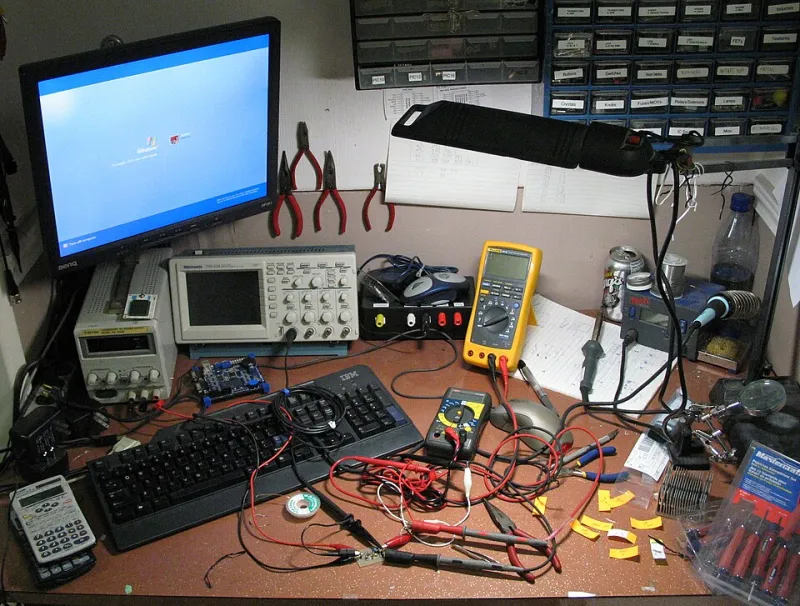
Photo: Crispin Purdye, CC BY-SA 2.0, via Wikimedia Commons
For most consumers, a power supply is an afterthought — a black brick that charges a laptop or a compact module tucked invisibly inside a medical device. For the engineers and procurement specialists who build those products, however, power supply components have become the central anxiety of 2024. Across the United States, manufacturers are confronting a shortage of specialized capacitors, inductors, power management integrated circuits (PMICs), and wide-bandgap semiconductors that is quietly disrupting production schedules, inflating costs, and forcing fundamental redesigns of products already in development.
This is not the same supply chain story that dominated headlines during the pandemic. The current crisis is more targeted, more technically nuanced, and in many ways more difficult to resolve.
The Anatomy of the Shortage
At its core, the problem stems from the intersection of several converging pressures. First, demand for power-dense, energy-efficient electronics has surged across virtually every sector — from electric vehicles and industrial automation to data center infrastructure and consumer wearables. Each of these markets requires highly specialized passive and active components that operate at precise voltage and current tolerances.
Second, the global production of these components remains heavily concentrated in East Asia, particularly in Taiwan, Japan, South Korea, and increasingly China. When geopolitical tensions — including export restrictions, tariff escalations, and regulatory scrutiny of Chinese-origin components — began tightening the flow of goods, American manufacturers found themselves exposed in ways that internal risk assessments had underestimated.
"We had single-source dependencies on specific MLCC [multilayer ceramic capacitor] families that we didn't fully appreciate until lead times jumped from eight weeks to fifty-two weeks overnight," said one senior electrical engineer at a mid-sized defense electronics contractor in the Mid-Atlantic region, who requested anonymity to speak candidly. "That kind of lag doesn't just affect your schedule. It affects your ability to quote on new contracts."
MLCCs — the small ceramic capacitors essential to nearly every power filtering and decoupling circuit — represent one of the most acute pressure points. Murata, TDK, and Samsung Electro-Mechanics collectively dominate global MLCC production, and allocations to US buyers have tightened considerably as automotive and consumer electronics demand competes for the same production capacity.
Geopolitics as an Engineering Variable
What makes the current shortage distinctly different from cyclical supply disruptions of the past is the degree to which policy decisions are now functioning as engineering constraints. The CHIPS and Science Act, signed into law in 2022, directed billions of dollars toward domestic semiconductor fabrication — but the benefits of that investment will take years to materialize at scale. In the interim, manufacturers are navigating an environment where the components they need may be subject to export controls, origin restrictions, or simply unavailable from approved vendors.
Wide-bandgap semiconductors — specifically gallium nitride (GaN) and silicon carbide (SiC) devices used in high-efficiency power conversion — illustrate this tension clearly. China has moved aggressively to restrict exports of gallium and germanium, two raw materials central to GaN production. While US and European suppliers are expanding capacity, the transition is neither fast nor inexpensive.
"GaN devices are not a commodity yet," explained a power electronics researcher at a major public university in the Midwest who consults with several OEMs. "You can't just swap in an alternative. The gate drive requirements, the thermal management, the PCB layout considerations — everything changes. A redesign around a different device family can take six to eighteen months depending on the application."
For industries where regulatory certification adds additional time — medical devices, aerospace, automotive — that timeline compounds dramatically.
Redesign as a Strategic Response
Rather than waiting for supply to normalize, a growing number of US manufacturers are treating the shortage as an inflection point for architectural change. Some companies are revisiting power topology choices, shifting from traditional flyback or forward converter designs toward topologies that rely on components with better availability profiles. Others are accelerating the adoption of digital power management platforms that offer greater flexibility in component selection.
A few forward-thinking firms are going further, investing in vertical integration strategies that bring more of the supply chain under direct control. This includes partnerships with domestic component distributors, long-term purchase agreements with Japanese and European suppliers, and in some cases, direct equity investments in specialty manufacturers.
Nearshoring — relocating portions of the supply chain to Mexico, Canada, or allied nations — has also gained traction as a risk mitigation strategy. The USMCA trade framework provides a relatively stable regulatory environment for electronics manufacturing across North America, and several major EMS (electronics manufacturing services) providers have expanded their Mexican operations specifically to serve US OEMs seeking geographic diversification.
The Long View: Building Domestic Resilience
Industry observers caution that nearshoring and redesign efforts, while necessary, are insufficient on their own. Building genuine resilience in the US power electronics supply chain requires sustained investment in domestic materials processing, component fabrication, and engineering talent development.
The Department of Energy's ongoing investments in power electronics manufacturing through programs like the PowerAmerica Institute represent meaningful steps in this direction. So do emerging collaborations between national laboratories and private industry aimed at accelerating the commercialization of next-generation power conversion technologies.
For electronics engineers working in US manufacturing today, the shortage has imposed real costs — in time, budget, and creative energy. But it has also focused attention on structural vulnerabilities that the industry had long deferred addressing. The companies that emerge from this period in the strongest position will likely be those that treated the disruption not merely as a procurement problem, but as an engineering challenge worthy of their full analytical capabilities.
At Electron Labs, we believe that understanding the systemic forces shaping component availability is as essential to modern electronics practice as mastering circuit theory. The voltage regulators and power management devices at the heart of this crisis are not peripheral concerns — they are the foundational infrastructure upon which every electronic system depends. Addressing their scarcity demands exactly the kind of rigorous, knowledge-driven approach that has always defined excellence in this field.