From Cloud to Circuit: The Engineering Principles Driving Intelligence to the Network's Edge
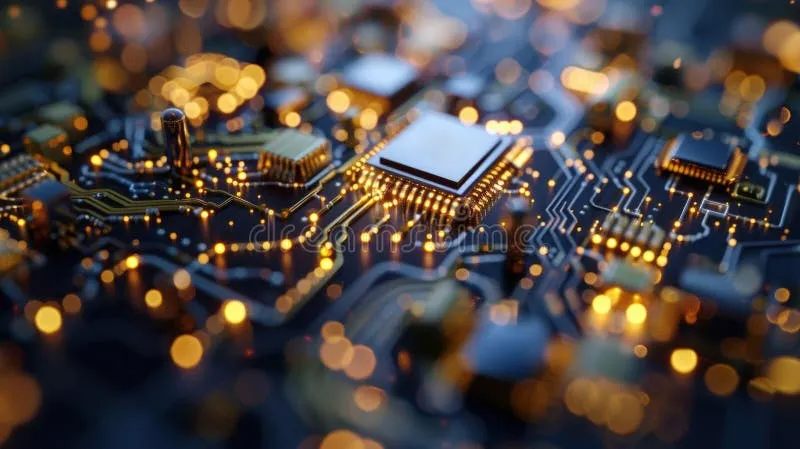
Photo: microcontroller IoT edge computing circuit board close up, via thumbs.dreamstime.com
For much of the past decade, the prevailing assumption in connected electronics was straightforward: capture data locally, transmit it to the cloud, and let remote servers handle the heavy lifting. That model served its purpose, but it also introduced latency, bandwidth costs, and dependency on network availability that engineers in time-sensitive applications found increasingly difficult to tolerate. Today, a quieter but more consequential shift is underway. Processing intelligence is migrating off distant servers and into the devices themselves—and the engineering challenges required to make that happen are reshaping how electronics professionals approach hardware design from the ground up.
Why the Cloud Is No Longer Enough
The limitations of centralized cloud processing have become especially apparent in applications where milliseconds matter. Industrial automation systems, autonomous vehicle subsystems, medical monitoring equipment, and agricultural IoT deployments all share a common requirement: they cannot afford to wait for a round-trip to a remote data center before making a decision. A robotic arm on a manufacturing line in Ohio or a smart irrigation controller in California's Central Valley needs to respond to its environment in real time, regardless of whether an internet connection is available.
Beyond latency, data privacy concerns have added additional pressure. Transmitting raw sensor data—particularly from devices operating in healthcare or defense-adjacent environments—raises compliance and security questions that edge processing can help mitigate. When sensitive inference happens locally and only aggregated, anonymized results are transmitted upstream, the regulatory exposure shrinks considerably.
The Resource Constraint Problem
The central engineering challenge of edge computing is, at its core, a problem of doing more with less. Cloud servers operate with essentially unconstrained compute and power budgets. A microcontroller drawing 10 milliwatts from a coin cell battery does not. Bridging that gap requires innovation across multiple layers of the hardware stack simultaneously.
Processor architecture has seen some of the most consequential advances. Dedicated neural processing units (NPUs) and hardware accelerators are now being integrated directly into microcontrollers and system-on-chip (SoC) designs at price points that were unthinkable five years ago. Devices such as the Arm Cortex-M series with Helium extensions, or purpose-built chips from companies like Ambiq and Nordic Semiconductor, are designed specifically to execute machine learning inference workloads at microwatt power levels. These are not general-purpose processors running neural network libraries as an afterthought—they are architectures purpose-built for the mathematical operations that dominate modern AI workloads.
Algorithm Optimization: Shrinking the Model Without Losing the Insight
Hardware improvements alone are insufficient if the software models they run remain bloated. The field of model compression has consequently become a critical discipline for engineers targeting edge deployment. Techniques such as quantization—converting 32-bit floating-point weights to 8-bit integers—can reduce model size by a factor of four while incurring only marginal accuracy losses on many inference tasks. Pruning removes redundant neural network connections, further reducing computational overhead. Knowledge distillation trains a smaller "student" model to replicate the behavior of a larger "teacher" model, yielding compact networks that punch above their weight.
Frameworks including TensorFlow Lite, PyTorch Mobile, and Edge Impulse have matured significantly, offering engineers automated pipelines that handle much of the compression and deployment workflow. The result is that models originally trained on cloud infrastructure can be adapted for microcontroller deployment with a fraction of the manual effort that process once required.
Power Architecture and Energy Harvesting
Deploying intelligence at the edge often means deploying it in locations where wired power is unavailable. This reality has elevated power architecture to a first-class design concern. Engineers are increasingly structuring edge devices around duty-cycling strategies, where the processor spends the vast majority of its operational lifetime in deep sleep and wakes only when a sensor event or scheduled interval demands attention.
Energy harvesting is advancing in parallel. Photovoltaic cells, thermoelectric generators, and piezoelectric transducers are being integrated into edge node designs, allowing devices to operate indefinitely in environments where battery replacement would be logistically or economically prohibitive. The engineering discipline required to balance harvested energy budgets against compute demands is nuanced and increasingly valuable.
Rethinking Hardware Architecture for Distributed Systems
Edge computing does not eliminate the cloud—it redefines the relationship between local and remote processing. Modern distributed electronics systems are increasingly organized into hierarchical tiers: resource-constrained end nodes handle immediate inference and filtering, gateway devices aggregate and perform more sophisticated analysis, and cloud infrastructure handles long-term storage, model retraining, and fleet management.
This tiered architecture places new demands on communication protocols and hardware interfaces. Engineers must make deliberate decisions about which data moves between tiers, at what frequency, and using which radio technology. Protocols such as LoRaWAN, Zigbee, Thread, and Matter each carry distinct trade-offs between range, bandwidth, power consumption, and ecosystem compatibility—trade-offs that must be evaluated against the specific requirements of each deployment.
Implications for Electronics Professionals
The migration of processing intelligence to the edge is not simply a software trend that electronics engineers can observe from a distance. It demands genuine hardware expertise. PCB designers must accommodate new SoC packages and thermal profiles. Firmware engineers must develop proficiency in deploying and optimizing inference runtimes on bare-metal systems. Systems architects must reason about latency, reliability, and security across heterogeneous device ecosystems.
For professionals and students building expertise in this space, the opportunity is substantial. The US market for edge AI hardware and software is projected to grow aggressively through the remainder of this decade, driven by manufacturing, healthcare, agriculture, and defense applications. Engineers who understand both the algorithmic and the physical dimensions of edge computing—who can optimize a neural network and design the power supply that keeps it running—will occupy a uniquely valuable position in the electronics industry.
The cloud is not going away. But the assumption that intelligence must live there, rather than in the circuit itself, is already obsolete.