Heat Is the Enemy: Why Thermal Management Remains Electronics Engineering's Most Costly Blind Spot
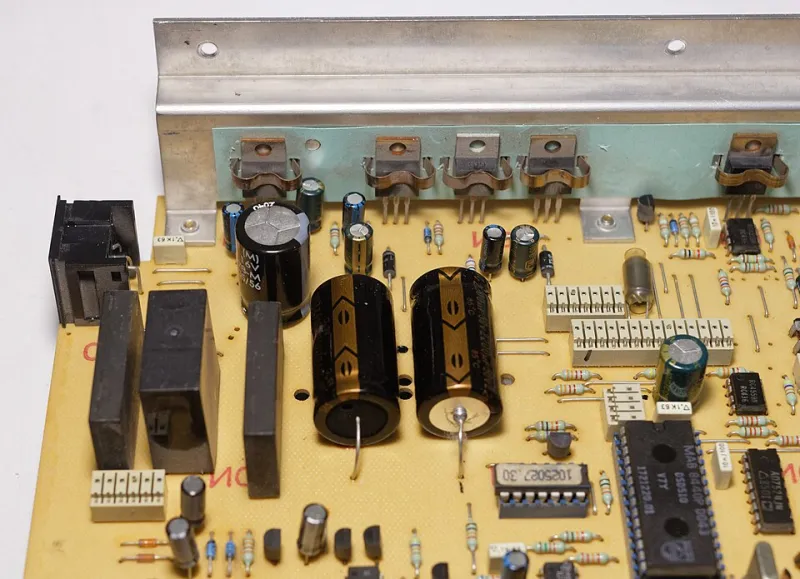
Photo: Retired electrician, CC0, via Wikimedia Commons
There is a quiet crisis unfolding inside the devices that power modern American life. It does not announce itself with a dramatic spark or a visible crack. Instead, it accumulates silently — a few degrees above the rated threshold, sustained over weeks or months — until a component fails, a product is recalled, or an expensive redesign consumes an engineering team's quarter. The culprit is thermal mismanagement, and according to industry data, it accounts for an estimated 55 percent of all electronic component failures in the United States.
Yet ask a room full of engineering students which discipline they spend the least time studying, and thermal management will likely top the list. It is the subject that falls between the cracks of circuit theory and mechanical engineering, claimed fully by neither, mastered by few.
The Physics of Failure
To understand why heat is so destructive, it helps to revisit what actually happens inside a semiconductor when temperatures rise. Every electronic component operates within a junction temperature range — a thermal window defined by its manufacturer beyond which the device's electrical characteristics begin to drift. Resistances shift. Capacitances change. Timing margins erode. For digital logic, this may mean intermittent errors that are nearly impossible to reproduce in a lab setting. For power electronics, it can mean catastrophic and irreversible breakdown.
The Arrhenius equation, long used in reliability engineering, quantifies the relationship between temperature and failure rate. As a rough rule of thumb, every 10°C rise in operating temperature can reduce a semiconductor's expected lifespan by as much as half. This is not a theoretical concern. Consumer electronics routinely operate in environments — inside enclosures, stacked in server racks, tucked beneath car dashboards in a Texas summer — where ambient temperatures already push components toward their limits before a single electron flows through the circuit.
Where Professionals Get It Wrong
The assumption that thermal management is a problem to solve at the end of a design cycle is perhaps the most expensive mistake in modern electronics development. Thermal considerations are frequently treated as a post-layout afterthought: an engineer routes the board, places the components, and only then asks whether the design will survive its own heat output.
This sequential approach creates compounding problems. By the time a thermal simulation reveals hotspots, the PCB layout is largely fixed. Moving a power stage or rerouting copper pours to improve thermal spreading requires revisiting decisions that were made weeks earlier. In production timelines measured in months, those revisions carry real financial weight.
Professional thermal engineers — the specialists who dedicate their careers to heat transfer analysis — often describe their role as arriving at a fire rather than preventing one. Computational fluid dynamics (CFD) tools such as Ansys Icepak and Mentor FloTHERM exist precisely to model airflow and thermal distribution before a board is ever fabricated. Yet in many smaller design shops and startup environments across the United States, these tools are either too expensive to license or too complex to integrate into an already-compressed development schedule.
The Hobbyist Blind Spot
The problem is not confined to professional engineering teams. In the maker and DIY electronics community — a space that has expanded dramatically with the availability of affordable microcontrollers and single-board computers — thermal awareness is often absent entirely.
Consider the common scenario of a maker building a compact Raspberry Pi-based media server, enclosed in a 3D-printed case with no ventilation provisions. The device may function flawlessly during initial testing, only to exhibit throttling, instability, or premature failure after weeks of continuous operation. The root cause is rarely a faulty component. It is an enclosure that traps heat, combined with a thermal budget that was never calculated in the first place.
Basic thermal management techniques — attaching appropriately sized heatsinks, selecting thermal interface materials with adequate conductivity, designing enclosures with deliberate airflow paths — are accessible to anyone with a modest electronics budget. A quality thermal interface material costs a few dollars. A small axial fan costs less. The knowledge required to deploy them correctly, however, is rarely taught in introductory electronics curricula.
Practical Techniques Worth Knowing
For engineers and enthusiasts looking to close this competency gap, several foundational techniques offer significant returns with relatively modest investment.
Thermal resistance modeling is the starting point. Every component in a thermal path — from the semiconductor junction to the ambient air — can be assigned a thermal resistance value, expressed in degrees Celsius per watt. Treating these values as a series circuit allows designers to calculate the expected junction temperature under a given power dissipation scenario before any hardware is built.
Copper pour strategy on PCBs is frequently underutilized. Expanding ground pours beneath high-power components, using thermal vias to conduct heat through board layers, and selecting higher-copper-weight laminates for power-dense designs are all techniques that cost little but contribute meaningfully to thermal performance.
Heatsink selection requires more than matching a component's footprint. Thermal resistance ratings for heatsinks are specified under particular airflow conditions. A heatsink rated at 5°C/W in free convection may perform significantly differently inside a sealed enclosure. Understanding these nuances prevents the false confidence that a heatsink's presence alone resolves a thermal problem.
Thermal imaging has become increasingly accessible. Entry-level thermal cameras compatible with smartphones are now available for under $300, enabling makers and small engineering teams to identify hotspots on powered boards in real time — a capability that was once reserved for well-funded labs.
The Industry Cost and the Path Forward
The financial toll of inadequate thermal management extends well beyond individual product failures. Field returns, warranty claims, and reputation damage associated with thermally induced failures cost the U.S. electronics industry billions of dollars annually. In sectors such as automotive electronics and industrial control systems, where component failure carries safety implications, the stakes are higher still.
The encouraging reality is that thermal engineering is a teachable, learnable discipline. Universities are beginning to incorporate thermal co-design into electrical engineering programs with greater intentionality. Online simulation tools with free tiers are making thermal modeling accessible to independent designers. And a growing community of thermal engineers is actively publishing educational content aimed at bridging the gap between theory and practice.
At Electron Labs, we believe that advancing electronics knowledge means confronting the uncomfortable gaps in how the field is taught and practiced. Thermal management is not a niche specialty reserved for aerospace applications. It is a foundational competency — one that every designer, from the professional PCB layout engineer to the weekend maker, has both the opportunity and the responsibility to develop.
Heat will always be a byproduct of moving electrons. The question is whether the engineers managing those electrons treat thermal design as a first-class citizen of the design process, or continue to discover, too late, that it should have been.