Counterfeit Components and the Crumbling Chain of Trust in Electronics Procurement
For decades, the conventional wisdom among procurement professionals was straightforward: purchase from an authorized distributor, receive genuine parts. That assumption, once reliable enough to serve as the foundation of an entire industry's quality assurance framework, is now dangerously obsolete. Counterfeit semiconductors — components that have been remarked, recycled, cloned, or fraudulently relabeled — are no longer a problem exclusive to bargain-bin brokers and offshore gray markets. They are appearing inside the inventories of distributors that engineers have trusted for years.
The scale of the problem is not trivial. The Semiconductor Industry Association has estimated that counterfeit components cost the global electronics industry billions of dollars annually, and independent research from the Government Accountability Office and various defense procurement audits has repeatedly confirmed that fake parts have reached sensitive applications including aerospace, medical devices, and military electronics. When a counterfeit microcontroller finds its way into a consumer product, the result may be an early failure or a warranty claim. When it reaches a safety-critical system, the consequences can be irreversible.
How Counterfeits Enter Legitimate Channels
Understanding the infiltration pathway requires dismantling the assumption that authorized distributors operate as impenetrable gatekeepers. In reality, the modern electronics supply chain is a layered, globally distributed network, and its complexity creates exploitable gaps.
The most common entry point is the spot market. When a component experiences a shortage — as the industry witnessed dramatically during the semiconductor supply crunch of 2020 through 2022 — distributors and contract manufacturers frequently turn to independent brokers to fill gaps in inventory. These brokers operate outside the manufacturer-authorized distribution network, and while many are legitimate, the lack of standardized vetting creates an opening for bad actors. Counterfeit components purchased in bulk from overseas recyclers or clone manufacturers can be introduced at this junction, sometimes with documentation sophisticated enough to pass initial inspection.
A second pathway involves recycled parts. Electronic waste processed in regions with limited regulatory oversight is sometimes stripped of functional-looking components, which are then cleaned, re-marked with higher-grade specifications, and sold as new. A microprocessor originally rated for consumer-grade temperature ranges may be relabeled as an industrial or military-specification part and sold at a corresponding premium. Electrically, the component may function under normal conditions — long enough to pass incoming inspection — while failing under the thermal or voltage stress conditions its fraudulent markings claim it can withstand.
Third-party fulfillment and e-commerce platforms present a third vector. Even reputable online marketplaces that aggregate multiple sellers have documented instances where counterfeit components were listed alongside genuine parts, sometimes within the same product listing, making it nearly impossible for a purchasing agent to distinguish one from the other at the point of order.
The Engineering Consequences of Fake Silicon
The risks posed by counterfeit components are not uniform. They depend heavily on what type of fraud has been committed and where the component ends up.
Remarked parts — genuine components that have been relabeled with false speed grades, temperature ratings, or manufacturer identities — represent perhaps the most insidious category. They may perform adequately in benign operating environments while degrading unpredictably when pushed toward their actual limits. An engineer who trusts a datasheet specification to design a power converter operating near its thermal ceiling has no margin to absorb the failure of a component that was never rated for that condition in the first place.
Cloned or fully counterfeit parts — those manufactured by unauthorized fabs attempting to replicate a genuine device — carry a different risk profile. Electrical characteristics may deviate significantly from the original, introducing instability that is extraordinarily difficult to diagnose. A counterfeit voltage regulator that exhibits slightly different transient response behavior can corrupt the power delivery to an entire subsystem, producing symptoms that appear to implicate the load rather than the source.
For manufacturers, the financial exposure extends well beyond the cost of the components themselves. Product recalls, rework labor, field service costs, liability exposure, and reputational damage can collectively dwarf the original procurement savings by orders of magnitude.
Authentication Techniques Every Engineer Should Know
The most effective defense against counterfeit components begins before a single part reaches the workbench. A layered verification approach — combining visual inspection, electrical testing, and documentation scrutiny — provides substantially better protection than any single method alone.
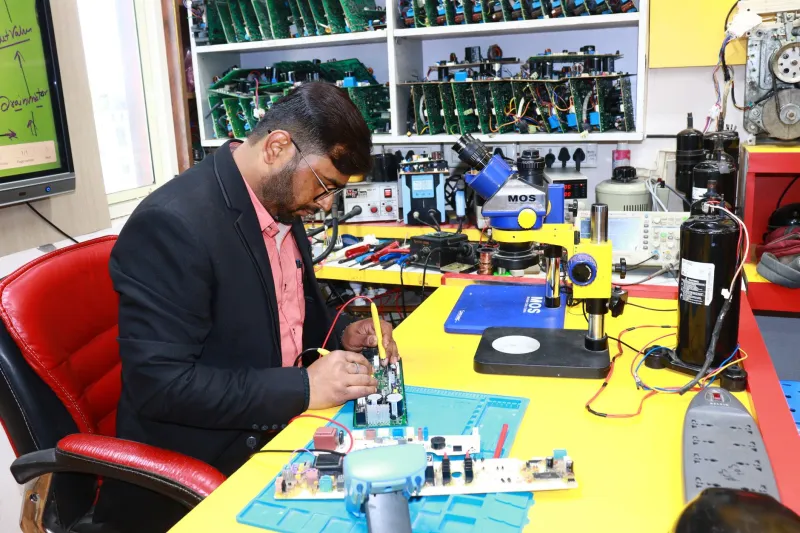
Visual and Physical Inspection Begin with a careful examination of the component's physical characteristics. Genuine parts from reputable manufacturers exhibit consistent marking quality, uniform laser or ink printing depth, and clean, undamaged lead finishes. Signs of remarking include sanding marks on the package surface, inconsistent font geometry, misaligned or blurry laser etching, and lead finishes that show evidence of stripping and re-tinning. A USB digital microscope — an inexpensive addition to any workbench — makes these details readily apparent. Date codes and lot numbers should also be cross-referenced with the manufacturer's known production history where possible.
X-Ray and Decapsulation Analysis For high-value or safety-critical procurement, X-ray inspection and chemical decapsulation offer a definitive view of internal die geometry. Authorized manufacturers maintain consistent internal architectures across production runs; counterfeit dies frequently reveal incorrect bond wire patterns, mismatched die sizes, or absent internal structures. While these methods require specialized equipment or third-party laboratory services, they are standard practice in aerospace and defense procurement and increasingly accessible through independent test houses.
Electrical Characterization Functional testing against the full specification — not merely a pass/fail check under nominal conditions — is essential. Parametric testing across the component's rated temperature range, supply voltage extremes, and timing margins will expose parts that perform adequately at room temperature but fail under stress. Automated test equipment can execute these profiles efficiently at scale, but even bench-level characterization using a temperature chamber and a calibrated oscilloscope provides meaningful screening capability.
Supply Chain Documentation Review Every legitimate component in an authorized distribution channel should be accompanied by a traceable documentation chain — certificates of conformance, manufacturer packing lists, and verifiable lot traceability back to the original factory. Requests for this documentation that are met with vague responses, missing records, or generic certificates not tied to a specific lot number should be treated as a serious warning indicator.
Enrollment in Manufacturer Verification Programs Many major semiconductor manufacturers now offer online verification portals where engineers can confirm whether a specific lot number and date code correspond to genuine production records. Texas Instruments, STMicroelectronics, and several other major vendors maintain these tools, and using them costs nothing beyond the time required to enter a part number.
A Structural Problem Demanding Structural Solutions
Authentication techniques address the symptom rather than the disease. The underlying vulnerability — a supply chain architecture that prioritizes cost efficiency and delivery speed over traceability — will continue to generate opportunities for counterfeit infiltration as long as demand volatility creates spot-market dependencies.
Industry organizations including the Electronic Components Industry Association and the Independent Distributors of Electronics have developed quality management standards, including AS6081 for counterfeit electronic parts avoidance, that provide a framework for distributor vetting. Engineers and procurement managers who specify adherence to these standards in their supplier qualification criteria add a meaningful layer of structural protection.
The broader lesson is that trust, in the context of modern electronics procurement, is not a property that can be assumed from a distributor's name or reputation alone. It must be actively maintained through verification, documentation discipline, and a willingness to invest the time and resources that genuine component assurance requires. In a field where the consequences of failure can extend far beyond the circuit board, that investment is not optional — it is the baseline obligation of professional practice.