Quantum in Your Pocket: How Decades of Laboratory Research Are Quietly Entering Everyday Electronics
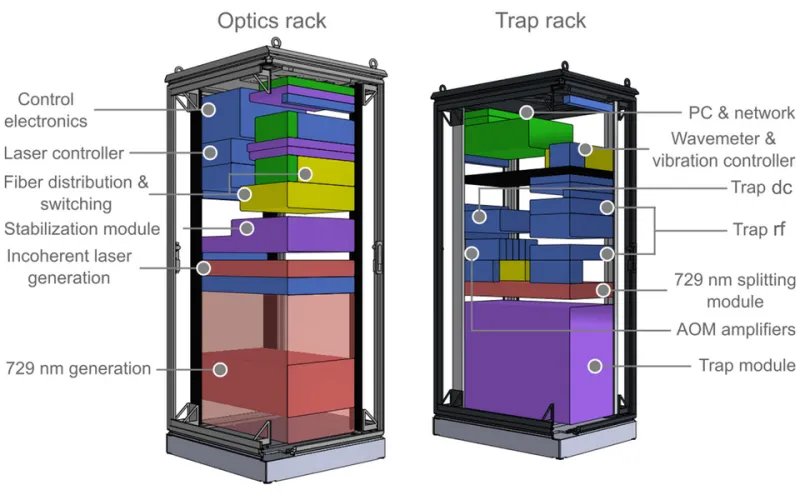
Photo: Authors of the study: I. Pogorelov, T. Feldker, Ch. D. Marciniak, L. Postler, G. Jacob, O. Krieglsteiner, V. Podlesnic, M. Meth, V. Negnevitsky, M. Stadler, B. Höfer, C. Wächter, K. Lakhmanskiy, R. Blatt, P. Schindler, and T. Monz, CC BY 4.0, via W
For most of its history, quantum computing has existed in a realm that felt comfortably distant from everyday technology — a fascinating theoretical discipline pursued in university physics departments and national laboratories, generating headlines but rarely affecting the devices that people actually use. That comfortable distance is beginning to close, and the pace of change is accelerating faster than public awareness has kept up with.
This is not a prediction that quantum computers will replace your laptop next year. The architecture of gate-based quantum processors remains far removed from the silicon transistors that power consumer electronics. But the principles underlying quantum mechanics are already making their way into the chips, security protocols, and sensing technologies embedded in devices that millions of Americans carry daily. Understanding the distinction — and the timeline — matters for anyone engaged with electronics engineering or technology education.
What Quantum Computing Actually Is (And Is Not)
A classical computer processes information as binary bits: each unit of data exists in one of two states, either zero or one. A quantum computer operates on qubits, which exploit the principles of superposition and entanglement to represent and process information in fundamentally different ways. A qubit can exist in a combination of states simultaneously, enabling certain classes of calculations to be performed exponentially faster than any classical system could achieve.
The critical qualifier is certain classes of calculations. Quantum computers are not universally faster than classical processors. They excel at specific problem types — optimization, simulation of molecular systems, and factoring large integers among them — while offering no meaningful advantage for the computational tasks that dominate everyday computing, such as rendering graphics, streaming video, or running a spreadsheet.
This specificity is essential context for understanding how quantum technology enters consumer electronics. The pathway is not through general-purpose quantum processors replacing conventional chips. It is through targeted applications where quantum principles provide a decisive advantage in a compact, manufacturable form.
Post-Quantum Cryptography: The Quantum Revolution Already in Your Devices
The most immediate and consequential intersection of quantum technology with consumer electronics is occurring in the field of cryptography — and it is already underway.
The encryption protocols that secure internet communications, financial transactions, and personal data rely on mathematical problems that are computationally intractable for classical computers. Prime factorization, the basis of RSA encryption, is one such problem. A sufficiently powerful quantum computer running Shor's algorithm could theoretically break RSA encryption in hours rather than the millions of years a classical machine would require.
That threat is not yet operational — current quantum processors lack the qubit count and error correction necessary to attack real-world encryption at scale. But the concern is credible enough that the National Institute of Standards and Technology (NIST) finalized its first set of post-quantum cryptographic standards in 2024, selecting algorithms specifically designed to resist quantum attacks.
Apple has already incorporated post-quantum cryptographic protections into iMessage through its PQ3 protocol, and the broader industry is moving toward integrating NIST-standardized algorithms into security chips and secure enclaves. The Secure Enclave in current iPhone hardware and the Titan M2 chip in Google's Pixel devices are examples of dedicated security processors that will increasingly incorporate quantum-resistant algorithms as firmware and hardware generations progress.
For electronics engineers and security professionals, this transition represents a significant and immediate area of applied development — one that does not require a quantum computer to build, but does require a thorough understanding of quantum computational threat models.
Quantum Sensing: The Less-Discussed Frontier
While quantum computing captures most of the attention, quantum sensing may prove to be the nearer-term pathway through which quantum physics enters consumer hardware in a tangible way.
Quantum sensors exploit the extreme sensitivity of quantum systems to physical disturbances. Because qubits are exquisitely responsive to their environment — a property that makes them difficult to maintain in computing applications — that same sensitivity can be harnessed for measurement at resolutions that classical sensors cannot approach.
Researchers at MIT, Stanford, and several DARPA-funded laboratories have demonstrated quantum magnetometers capable of detecting magnetic field variations at the femtotesla scale, with potential applications in medical imaging, geological surveying, and navigation systems that do not rely on GPS. Compact atomic clocks based on quantum principles are already used in telecommunications infrastructure and are being miniaturized for potential integration into mobile devices.
In the smartphone context, quantum-enhanced inertial measurement units (IMUs) could eventually enable indoor navigation with centimeter-level accuracy, a capability that current MEMS-based accelerometers cannot reliably achieve. The engineering challenges of packaging quantum sensing elements into consumer-grade form factors remain substantial, but the research trajectory is encouraging.
The Engineering Challenges That Remain
Honesty requires acknowledging the distance between current capabilities and the consumer quantum future that technology optimists sometimes describe. Gate-based quantum processors require cooling to temperatures near absolute zero — conditions achievable in a laboratory cryostat but entirely impractical in a handheld device. Qubit coherence times remain short, and error rates in current systems necessitate extensive error correction overhead that consumes a large fraction of available qubits.
Topological qubits, which Microsoft has pursued as a more inherently stable alternative to superconducting or trapped-ion architectures, have shown promise but have not yet been demonstrated at scales relevant to practical computation. Photonic quantum computing, which operates at room temperature using photons rather than superconducting circuits, represents another architectural pathway with distinct advantages for communication applications, though it faces its own scalability challenges.
The honest timeline for a general-purpose quantum processor capable of outperforming classical computers on commercially relevant tasks — what researchers call "quantum advantage" at scale — remains uncertain. Estimates from credible researchers range from five to twenty years, with considerable variance depending on which architectural approach ultimately prevails.
What Electronics Enthusiasts and Students Should Watch
For the Electron Labs audience — engineers, makers, and students engaged with electronics at a practical level — several developments are worth tracking closely.
The expansion of cloud-based quantum computing access through platforms such as IBM Quantum, Amazon Braket, and Google's Quantum AI has made it possible to program and experiment with real quantum hardware without institutional affiliation or specialized equipment. IBM's quantum network currently provides access to processors with over 100 qubits, and the programming frameworks — particularly Qiskit — are well-documented and accessible to anyone with a background in classical programming.
For those focused on hardware, the field of quantum-classical hybrid systems is an active area of development. These architectures pair classical processors with quantum co-processors to handle specific computational tasks, a model that may represent the practical near-term integration point between quantum technology and conventional electronics design.
The post-quantum cryptography transition, meanwhile, is an immediate and applied domain where electronics engineers can develop relevant expertise today. Understanding the NIST-standardized algorithms — CRYSTALS-Kyber for key encapsulation and CRYSTALS-Dilithium for digital signatures among them — and their implementation in embedded security hardware is a skill set with growing demand across the defense, finance, and consumer electronics sectors.
Quantum technology is not arriving all at once, and it is not arriving in the form that science fiction has suggested. But it is arriving — incrementally, practically, and with genuine engineering significance. The laboratory and the pocket are closer together than they have ever been.